
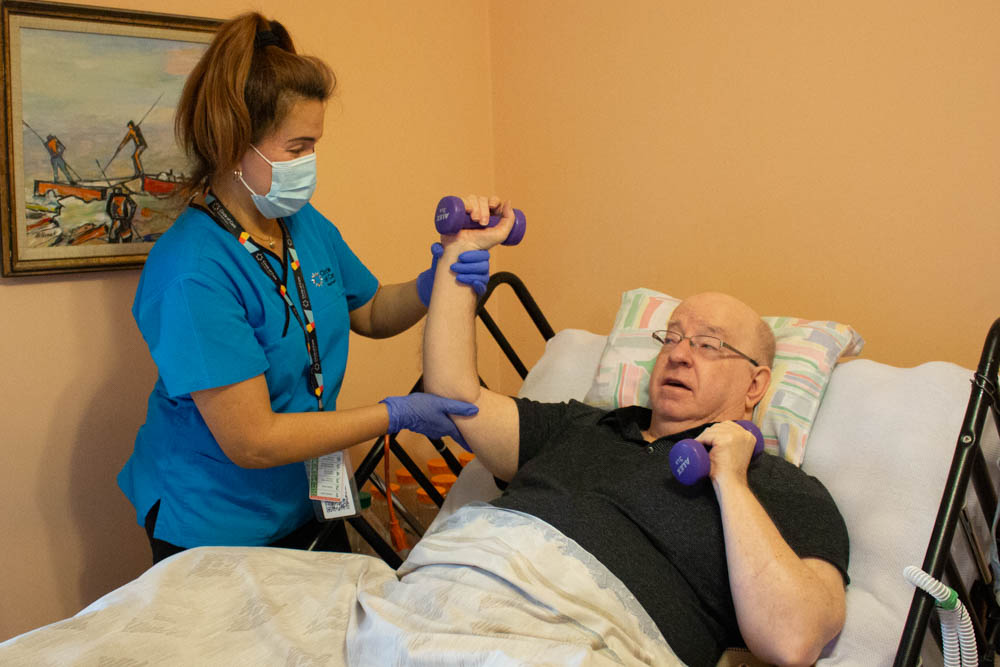
ROM Exercises: Exercises that help preserve the flexibility and mobility of joints on which they are performed. These exercises reduce stiffness and will prevent or slow down freezing of the client’s joints.
- Passive ROM Exercises: The PSW moves the client’s body part manually to complete the full range of motion exercises.
- Active ROM Exercises: The client performs the full range of motion exercise without assistance.
- Active-assistive ROM Exercises: The client requires assistance from the PSW to complete the full range of motion exercises.
PSW Considerations:
- Always follow the care plan specific to the client as prescribed by the physiotherapist.
Required Supplies:
- The provided diagrams of physiotherapist-prescribed exercises
Procedure for ROM Exercises:
Passive ROM Exercises
- Follow the instructions provided by the CSS and PT.
- Find a comfortable position for the client and yourself.
- Exercises may be performed while the client is in bed.
- Begin the exercises slowly, doing each exercise a few times only and gradually building up to more.
- Try to achieve the full range of motion by moving until you feel a slight stretch, but do not force a movement.
- Move only to the point of resistance. Do not force the movement.
- Keep the limbs supported throughout motion.
- Move slowly, watching the client’s face for a response to the ROM exercise.
- Stop the exercise if the client feels pain. Remind the client to tell you right away if they feel increased pain that does not subside after stopping the exercise.
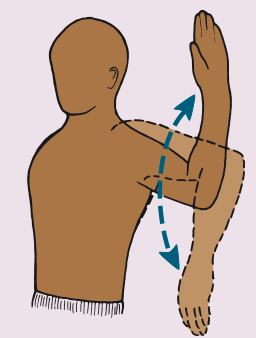
Active ROM Exercises
- Follow the instructions provided by the CSS and PT.
- Supervise the client while they perform the exercises.
- Remind the client to:
- Begin the exercises slowly, doing each exercise a few times only and gradually building up to more.
- Move only to the point of resistance. Do not force the movement.
- Watch the client’s face for a response to the ROM exercises.
- Instruct the client to stop if they feel pain. It is normal for the client to feel some discomfort at first, but the pain should subside quickly after stopping the exercise.
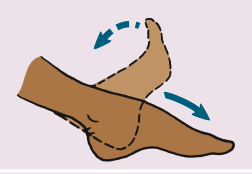
Active-assistive ROM Exercises
- Follow the instructions provided by the CSS and PT.
- Find a comfortable position for the client and yourself. Exercises may be performed while the client is in bed.
- Begin the exercises slowly, doing each exercise a few times only and gradually building up to more.
- Try to achieve the full range of motion by moving until you feel a slight stretch, but do not force a movement.
- Move only to the point of resistance. Do not force the movement.
- Keep the limbs supported throughout the motion.
- Move slowly, watching the client’s face for a response to the ROM exercise.
- Stop the exercise if the client feels pain. Remind the client to tell you right away if they feel increased pain that does not subside after stopping the exercise.
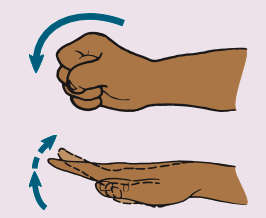
Video Resource
Please click on the video link below for a visual demonstration of the procedure:
References:
ALS Worldwide. (2004). Range of motion exercises.
https://alsworldwide.org/assets/misc/RANGE_OF_MOTION_EXERCISES_WITH_PHOTOS_copy.pdf
Drugs.com. (2023, May 1). Active range of motion exercises.
https://www.drugs.com/cg/active-range-of-motion-exercises.html
Drugs.com. (2023, May 1). Passive range of motion exercises.
https://www.drugs.com/cg/passive-range-of-motion-exercises.html
Potter, P., Perry, A. G., Stockert, P., Hall, A. (2019). Canadian fundamentals of nursing (6th ed,. Astle, B. J., & Duggleby, W. Eds.). Elsevier Canada.
Whatcom Community College. [whatcomptassistant]. (2011, October 27). Passive Range of Motion Exercises: Physical Therapy Assistant Skills Video #3 [Video]. YouTube.
https://www.youtube.com/watch?v=ouOtMnigomI&ab_channel=whatcomptassistant