
Catheter: Tube inserted into the urethra that drains urine from the bladder.
Catheter Care: Cleaning the catheter drainage bag in order to reduce the risk of infection.
CSS Considerations:
- Ensure the client has more than one urine drainage bag available.
- Determine the frequency of emptying/changing the urine drainage bag for the client.
- Ensure client has all necessary cleaning solutions and supplies required for catheter care.
PSW Considerations
1. Report before end of day to the office at 416-635-2860 if the following is observed or identified:
- There is no urine in the drainage bag (normal urine output is 30 cc/hr)
- Urine has blood, pus, or discolouration (i.e., cloudy, pink, red-tinged)
- Urine has an abnormal or foul odour
- Pain in the flank (just below the rib cage and above the waist on either side of the back)
- Pain or burning while urinating
- A frequent urge to urinate without being able to pass much urine
- Client has a fever or chills
2. Before procedure:
- Inspect the client’s skin integrity before proceeding (i.e., bleeding, sores, redness, lumps etc.). Do not proceed if there are any abnormal findings and report to office immediately.
- Perform a visual inspection of the urine bag, tubing, and catheter:
- Inspect cleanliness
- No cracks or breaks
- No blockage or kinks
- No residue buildup
Required Supplies:
- Soap (for hand hygiene)
- Gloves
- Urinary drainage bag and tubing
- Towel, cloth, or disposable pad
- Plastic squirt bottle
- Replacement catheter bag
- Cleaning solution:
- Vinegar solution: 1 part vinegar to 3 parts cold water, or
- Bleach solution: 1 part bleach to 10 parts cold water
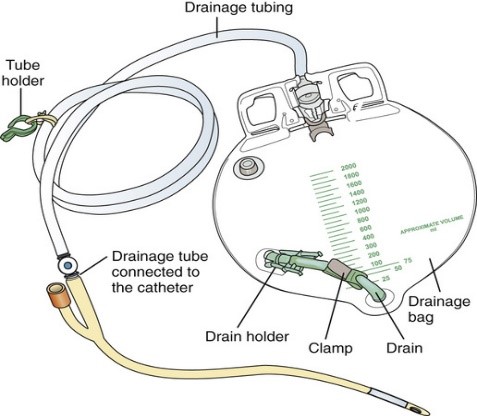
Procedure for Catheter Care
Changing the Urine Drainage Bag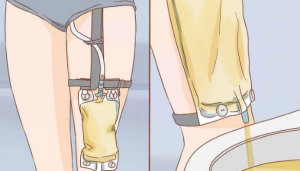
1. Wash hands thoroughly with soap. Put on gloves.
2. Place a towel, cloth, or disposable pad under the connection to catch any leaks..
3. Disconnect the catheter from the tubing of the urine bag.
- Do not tug on the catheter end.
- Do not touch the tube or catheter ends as you disconnect them.
4. Using a cleansing solution, wash:
- The connector
- The end of the drainage bag tubing
- The tubing end of the replacement bag (if the bag is not sterile)
5. Securely attach the tubing of the bag to the catheter. Ensure that the drainage clamp is in the locked/closed position.
6. Cap the tubing end of the urine bag just removed.
7. Check the catheter and drainage tubing to ensure there is no twisting of either supplies.
8. Remove gloves and wash hands.
Emptying the Urine Drainage Bag
1. Wash hands thoroughly with soap. Put on gloves.
2. Be sure to keep the drainage bag below the level of the bladder (approximately at the hip) to prevent backflow of urine.
3. Empty the bag into the toilet unless otherwise directed.
4. Carefully open the clamp at the bottom of the bag to empty it. Do not allow the clamp to touch the toilet.
5. Clean the connector using the cleansing solution, if available.
6. Securely close the clamp to prevent leaking. Do not put the drainage bag on the floor.
7. Remove gloves and wash hands.
Cleaning the Drainage Bag
1. Wash hands thoroughly with soap. Put on gloves.
2. Disconnect the catheter from the urine bag. Do not tug on the catheter end.
3. Using a plastic squirt bottle, rinse the urine bag and tubing with water.
4. Use either one of the solutions below to clean the drainage bag:
- Vinegar solution: 1 part vinegar to 3 parts cold water, or
- Bleach solution: 1 part bleach to 10 parts cold water
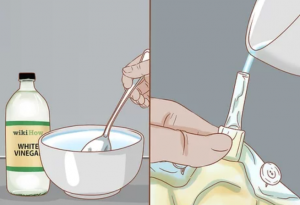 5. Pour the solution into the urine bag and tubing. Shake for 30 seconds and then drain the solution out of the bag.
6. Allow the bag to air dry.
7. Remove gloves and wash hands.
Video Resource
Please click on the video links below for a visual demonstration of the procedure:
Maintaining a Catheter
Emptying the Drainage Bag
Changing the Drainage Bag
References
Alberta Health Services (2020). Indwelling catheter: Care instructions.
https://myhealth.alberta.ca/health/AfterCareInformation/pages/conditions.aspx?hwid=custom.ab_indwellingcatheter_inst
Bassett Medical Center. (2013). How to care for your foley catheter.
https://www.bassett.org/sites/default/files/Patient%20Ed/edu_629.pdf
CareChannel. (2019, August 28). How to maintain a catheter [Video]. YouTube.
https://www.youtube.com/watch?v=SS35s-fUDkk&ab_channel=CareChannel
Cleveland Clinic. (2020). Urine drainage bag and leg bag care.
https://my.clevelandclinic.org/health/articles/14832-urine-drainage-bag-and-leg-bag-care#:~:text=Rinse%20out%20the%20leg%20bag,drainage%20bag%20the%20same%20way
PostCare Discharge Series. (2009, December 19). Postcare patient education emptying
a urinary drainage bag [Video]. YouTube.
https://www.youtube.com/watch?v=Joak7EA4v44&ab_channel=PostCare%E2%84%A2DischargeSeries
Potter, P., Perry, A. G., Stockert, P., Hall, A. (2019). Canadian fundamentals of
nursing (6th ed,. Astle, B. J., & Duggleby, W. Eds.). Elsevier Canada.
Preop.com Patient Engagement – Patient Education. (2017, June 18). Foley catheter
and drainage bag care, male – patient education [Video]. YouTube.
https://www.youtube.com/watch?v=mvVMucMoqGA&ab_channel=PreOp.comPatientEngagement-PatientEducation
Stratton, K.L. (2023). Indwelling catheter care. MedlinePlus.
https://medlineplus.gov/ency/patientinstructions/000140.htm