
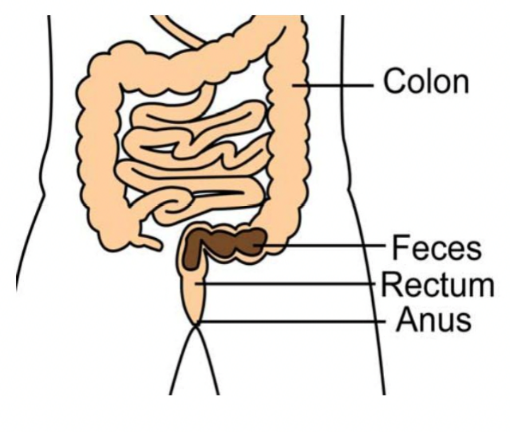
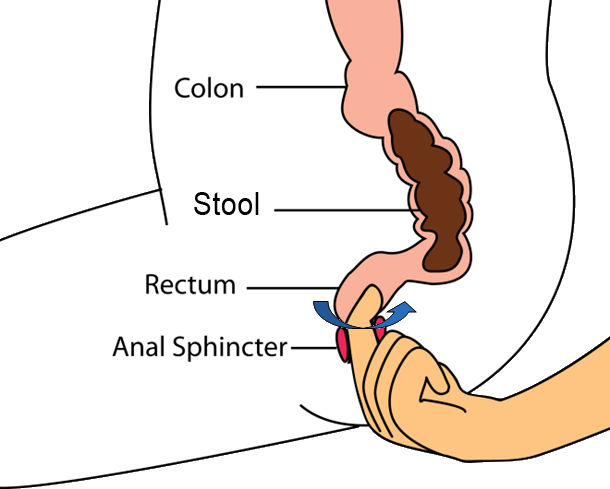
Digital Stimulation: A technique where fingers are inserted into the rectum. This technique trains the bowels to go at specific times, preventing bowel accidents and constipation. Digital stimulation is a way to empty the bowel after a spinal cord injury by stimulating the bowel reflex and opening the rectal muscles, which allows stool to leave the body.
CSS considerations:
- Active HCCSS referral – The frequency of the procedure must be outlined in the HCCSS referral.
- The procedure and the risks and benefits of the intervention must be explained to the client.
- The client’s medical condition must be stable and the client must be cognitively well and able.
- The client must have received the intervention for 3 months before the CSS delegation occurs.
- CSS to reassess the client within 6 months and update HCCSS as needed.
- The PSW must be comfortable and competent to carry out the delegation safely.
- CSS to follow-up with PSWs within 6 weeks of delegation training to reassess skills, competency, and comfortability.
- The client must be able to communicate health care needs.
- A skin assessment must be completed prior to delegation.
PSW Considerations:
- If the client expresses any discomfort verbally or non-verbally (i.e. pain or grimacing) during the procedure, stop the procedure immediately.
- Be aware of abnormal outcomes (i.e. pain, discomfort, etc.)
- Understand the normal vs adverse findings of stool (i.e. colour, texture, etc.)
- Report any abnormal findings to the office at 416-635-2860:
- Colour of stool – bright red traces, unexpected change in colour from client’s normal
- Texture of stool – very hard, loose/runny
- Bleeding in or around the rectum and anus
- Skin tears or other skin break down
- Hemorrhoids or unusual growths
- Abdominal pain and / or extreme discomfort
- Prolapse – when part of the rectum slips outside the muscular opening at the end of the anus
- Presence of mucous in the stool
Required Supplies:
- Gloves
- Lubricant
- Soap and water
- Washcloth
- Toilet paper
- Under pads
- Plastic bag (to throw away waste)
- Raised toilet seat (if done in bathroom)
Procedure for Digital Stimulation:
- Gather supplies and wash hands thoroughly.
- Prepare all the needed supplies and place them on a towel.
- Position yourself beside the client’s bed and have the client positioned lying down.
- Have the client on their left side with their knees flexed (right leg over the left leg) and place a disposable pad under the buttocks.
- Put gloves on both hands.
- Lubricate the index finger.
- Gently put the index finger into the rectum past the muscle, no further than 1 inch.
- Begin to gently move the finger around in a circular motion for about 30 seconds.
- When the stool begins to empty from the rectum, remove the finger so the stool can pass. You may need to gently remove stool from the rectum with your finger if it does not come out on its own.
- If no stool passes, repeat every 5-10 minutes until the bowel is empty or until the client is no longer able to tolerate the procedure.
- If no stool passes within 15-20 minutes, stop the procedure and report to the office at 416-635-2860 once the procedure is complete.
- Wipe the rectal area and buttocks, throw out waste, remove gloves, and wash hands thoroughly.
- Apply clean gloves and wash the client’s perineal area with soap and water.
- Dry with a towel.
- Reposition the client.
- Perform hand hygiene, and report all abnormal findings to the office at 416-635-2860.
Video Resource
Please click on the video link below for a visual demonstration of the procedure:
References:
- SCIU Courses. (2012, September 22). Bowel – Digital stimulation [Video]. YouTube.
https://youtu.be/O7cFvr3-DX8 - Shepherd Center. (2020). Digital stimulation.
https://www.myshepherdconnection.org/sci/bowel-care/digital-stimulation - University Health Network. (2015). Digital stimulation (Rectal touches).
https://www.uhn.ca/TorontoRehab/Spinal-Cord-Rehab/Spinal-Cord-Essentials/Documents/Self-Care/SCE2-Sb1-Digital-Stimulation-Rectal-Touches.pdf