
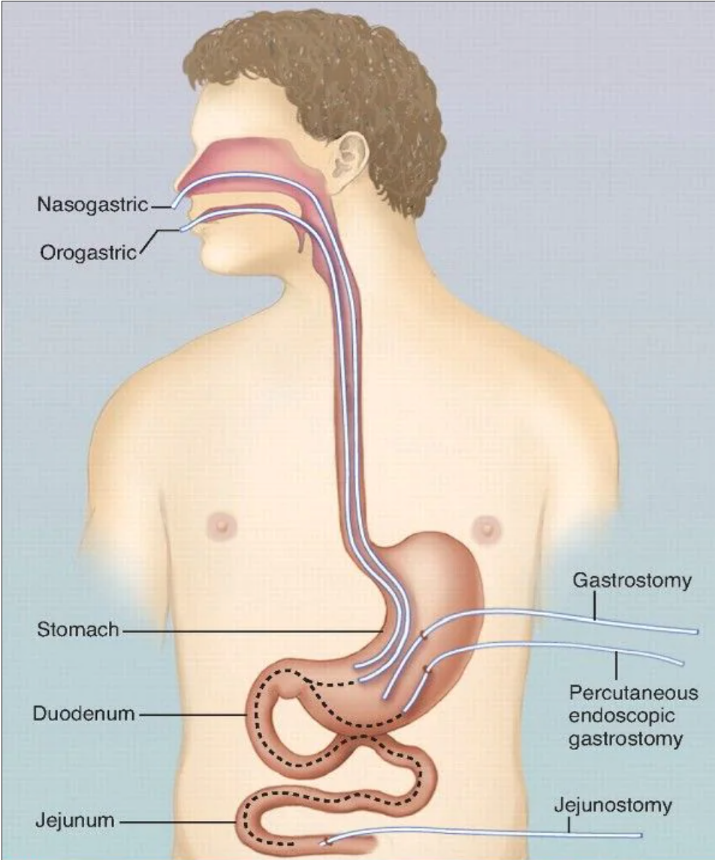
Enteral Feeding: A therapy where a feeding tube supplies nutrients to people who cannot get enough nutrition through eating. A flexible tube is inserted through the nose or belly area to provide nutrients by delivering liquid nutrition directly into the stomach or small intestine.
PSW Considerations:
- The Ontario Personal Support Worker Association states that PSWs can provide enteral feedings using gravity or a pump (not syringe). The regulated health professional providing the education must be confident in the competency of the PSW to perform the task. The CSS can instruct the PSW in the following:
- Monitoring the enteral site, and its integrity
- Ensuring that the tube is in its correct position
- Cleaning around the insertion site and looking for signs and symptoms of infection
- Signs of food or residual backup through the insertion site
- Clear instructions on the amount and scheduling of food and water to be included in the plan of care
- Proper positioning, maintaining patency, and reporting of blockages
- Signs or symptoms that the client is not tolerating the feed
- When to stop the feeding immediately and when to report to the office at 416-635-2860 or call 911
Proper Storage of the Feeding Formula:
- Store in a closed container in the fridge for no longer than 24 hours and then discard.
- Check the expiration date and discard if expired.
- Allow the feeding formula to come to room temperature before administering the feeding.
Required Supplies:
- Water and soap
- Gloves
- Feeding tube
- Formula container
- Feeding bag
- Clean, wet cloth
- IV pole (if needed)
- Syringe
- Lukewarm water
- Adapter (for the feeding tube)
Procedure for Enteral Feeding
Preparing the Client for the Tube Feeding
- Wash hands thoroughly with soap. Put on gloves.
- Check the prescription for the tube feeding and recommendations from the registered dietician. Check the 10 rights of medication administration.
- 10 rights of medication administration
- Right client
- Right medication
- Right route
- Right time
- Right dose
- Right reason
- Right response
- Right education
- Right documentation
- Right to refuse
- 10 rights of medication administration
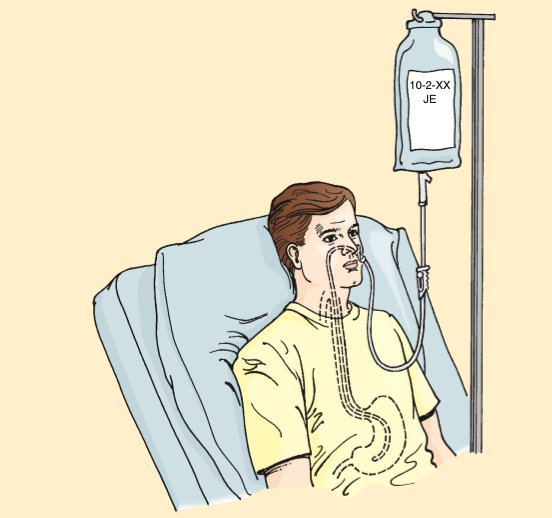
- Instruct the client to sit up in a chair or in semi-fowler’s position during the tube feeding. If they are unable to do so, use a pillow to prop their torso up to at least 45 degrees.
- Wipe the top of the formula container with a clean, wet cloth.
- Shake the container gently.
- Make sure the clamp is closed on the tubing from the feeding bag.
- If using a pre-filled formula container, spike it with the feeding set as shown by the health care professional. If not using a pre-filled container, pour the formula into the feeding bag and close the top of the bag.
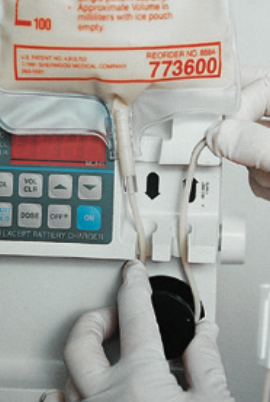
- If using an IV pole, hang the feeding bag on the pole above the feeding pump at least 18 inches above the client’s abdomen.
- Open the plug at the end of the client’s feeding tube.
Starting the Tube Feeding
- Insert the syringe into the feeding tube and flush the feeding tube using the prescribed amount of lukewarm water.
- If there is a button, insert the adapter into it. If the tube does not have a clamp, pinch the end of the tube to avoid leakage or put the tube in a cup.
- Attach the tip on the end of the feeding bag tubing to the client’s feeding tube.
- Open the side/roller clamp to adjust the flow rate as per the doctor’s order.
- The following information is to be filled by the CSS, as per the doctor’s order.
- _____ drips or ______ mL per _________ seconds or set the rate on the pump to __________________
- Each feeding should take about _____ minutes.
- After the feeding, close and take off the feeding bag tube. You may be asked to pour a certain amount of water into the feeding bag and run this before disconnecting the feeding bag from the feeding tube.
After the Tube Feeding
- Unclamp the feeding tube.
- Fill the syringe with the amount of water recommended by the healthcare professional.
- Insert the syringe into the feeding tube and flush the feeding tube using the specified amount of lukewarm water.
- Clamp the feeding tube, remove the adapter, and then cap the feeding tube.
- The client should remain in an upright position for 30-60 minutes after the feeding is finished to reduce the risk of aspiration.
- If using a disposable container, dispose of it in the garbage. If using a reusable container, use dishwashing liquid and water to wash the container. Rinse the container very thoroughly. Use a clean food container for each feeding.
- Remove gloves. Wash hands thoroughly with soap.
Caution
- Never change the rate of the feed from what is prescribed by the medical professional.
- Never rush when flushing the tube. Always push slowly.
- Do not administer medications through the feeding tube.
- Do not add medications to the feeding bag.
- Do not administer anything through the feeding tube other than water or the prescribed feeding formula.
- Do not dilute the formula.
- Flush the feeding tube only with water.
- The client needs to be sitting upright or with the head of bed raised at least to 45 degrees while the feeding is in progress.
- The client should continue to be upright for 30-60 minutes after the feeding or through the night if they are receiving continuous feeds.
- Flush the tube using a syringe with lukewarm water before and after feedings to prevent clogging. Flushes should be included in the prescription. For continuous feeds, flushes should occur 4-6 times per day because this is the client’s water intake for the day.
When to Call the Office
- Diarrhea greater than 2-3 days
- Constipation greater than 3-4 days
- Nausea or upset stomach greater than 24 hours
- Vomiting
- Dehydration
- Client reports a missed feed to the PSW, or refuses a feed
- Feeding formula supply is low or unavailable for upcoming days
- Any other supplies needed for the feed are low or unavailable
- Fever, weakness, or other unexplained symptoms
- The formula will not pass through the feeding tube (stop feed)
When to Call 911
- If the client is seen to be choking, coughing up formula, wheezing, or having trouble breathing, stop the feeding and call 911 immediately and then call the office at 416-635-2860 after.
- If the feeding tube has fallen out of the body, call 911 immediately and then call the office after.
Video Resource
Please click on the video link below for a visual demonstration of the procedure:
References
- BrainKart.com (2018). Nursing process: The patient receiving a tube feeding.
https://www.brainkart.com/article/Nursing-Process–The-Patient-Receiving-a-Tube-Feeding_32067/ - Cleveland Clinic. (2019, November 1). Introduction to home tube feeding [Video].
YouTube. https://youtu.be/zls5pP7OgOM - Cleveland Clinic. (2019). Tube feeding (Enteral nutrition).
https://my.clevelandclinic.org/health/treatments/21098-tube-feeding–enteral-nutrition#:~:text=Tube%20feeding%20is%20a%20therapy,the%20stomach%20or%20small%20intestine - Michael Garron Hospital. (2019). Guide to tube feeding for patients and families.
https://www.tehn.ca/sites/default/files/file-browser/guide_to_tube_feeding_web_dec_2019.pdf - Nestle Health Science. (2019). Your guide to home tube feeding.
https://www.nestlehealthscience.ca/sites/default/files/2019-12/Your-Guide-to-Home-Tube-Feeding.pdf - Nestle Health Science. (2019). Your tube feeding resource hub.
https://www.nestlehealthscience.ca/en/mytubefeedingadult/instructions-and-education - Option Care Health. (2020, July 8). Tube feeding using a pump [Video]. YouTube.
https://youtu.be/XbZLxLEHS6U