
Mechanical lifts: Devices used to assist with transfers and movement of individuals who require support for mobility beyond the manual support provided by caregivers alone
PSW Considerations:
- Mechanical lifts are designed for short distance transfers only (e.g. bed to chair).
- Two people are required for safe transfers using a mechanical lift for the client.
- This could include a family member, caregiver, or untrained PSW as the secondary helper.
- There must be a trained PSW, family member, or caregiver as the primary lift operator.
- The primary lift operator must provide clear instructions to the secondary helper and lead the transfer.
- Do not transfer the client using a mechanical lift if there are any changes to the client’s condition (e.g. the client is agitated, resistant, combative, or their physical/medical condition is worsening).
- Report any change in the client’s condition to the office at 416-635-2860.
- Make sure you recognize and understand the alarms and error messages on the mechanical lift. Always follow through when you hear an alarm.
Required Supplies:
- Sling
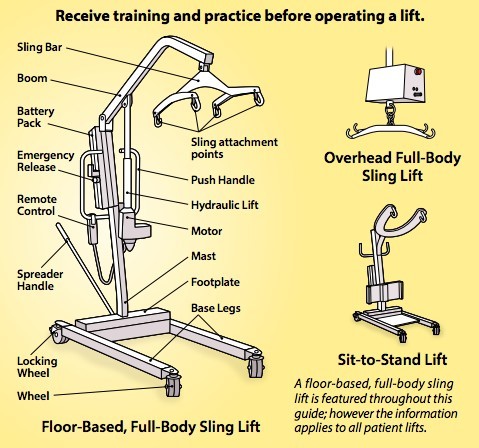
- Mechanical lift with sufficiently charged battery
- Prepared receiving surface
Procedure for Mechanical Lift Transfer:
First Safety Check:
- Turn the lift “ON.”
- Perform a safety check before beginning the transfer:
- Ensure the mechanical lift is in proper working condition, structurally sound, and the battery is sufficiently charged before use.
- Ensure there is space for the lift to pivot and move freely to the receiving area.
- Ensure the lift is able to fit under or around the receiving surface.
- Test the lift controls before bringing the lift to the client. Make sure the emergency release feature works.
- Ensure the receiving surface is stable and the brakes are locked.
- Examine the sling and attachment areas for tears, holes and frayed seams. DO NOT USE a sling with any signs of wear.
Place the Client in the Sling:
- Position the sling in the centre of the client’s spine.
- Place the leg straps flat under the client and do not let the material fold.
- Make sure the sling opening is not large enough to let the client slip out or too small to let the client fall out.
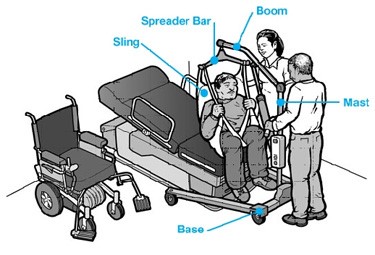
- Position the base of the lift and widen the base.
- Lower the sling bar down to the client. Do not let the sling bar hit the client.
- Attach the sling straps to the sling bar as directed.
- Use the matching loops from each side to ensure the sling is balanced.
- Ensure all clips or loops are secure and will stay attached as the client is lifted.
- Ensure the straps are not twisted.
- Ensure the client’s head and/or back are supported, as needed.
Second Safety Check:
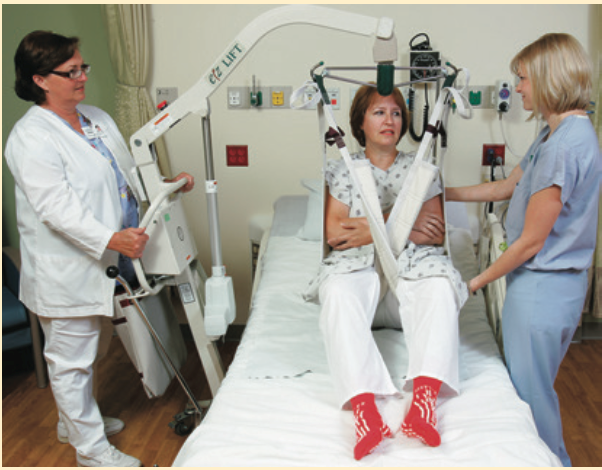
- Before lifting the client, perform safety check again:
- Examine all hooks and fasteners to ensure they will not unhook during use.
- Double-check the position and stability of the straps and mechanical lift before lifting the client.
- Ensure clips, latches and bars are securely fastened.
Raise the Client:
- Lift the client two inches off the surface to make sure the client is secure.
- Check the following:
- The sling straps are confined by the guard on the sling bar and will not disengage.
- Weight is spread evenly between the straps.
- The client will not slide out of the sling or tip backward or forward.
- Check the client’s comfort:
- Make sure the sling does not pinch or pull the client’s skin.
- Ask if the client is comfortable.
- Look for non-verbal signs of discomfort.
- Slowly lift the client only as high as necessary to complete the transfer.
Lower the Client:
- Slowly move the mechanical lift towards the receiving surface.
- Slowly lower the client towards the receiving surface. Move the client’s body into the correct position on the receiving surface before releasing the client’s weight.
- Release the client’s weight on the receiving surface.
- Do not let the sling bar hit the client.
- Detach the sling from the mechanical lift as per the training instructions
- Carefully remove the sling from the client’s body.
- Be careful not to hurt the client’s skin.
- Ensure that seated clients do not fall forwards as the sling is removed.
- If the power fails, use the emergency release feature to lower the client manually onto a receiving surface.
- Pull the mechanical lift away and close the base.
- Turn the mechanical lift “OFF” and plug it in to recharge the battery.