
What is Naloxone?
Naloxone (pronounced na-LOX-own,) is a drug that can temporarily reverse an opioid overdose. Opioids are drugs that can be used to treat pain, but the addictive properties of opioids can result in dependence.
Naloxone Nasal Spray (Narcan): Sprayed directly into the nose, where it is absorbed. It starts to take effect in 2 to 3 minutes.
PSW Considerations:
- Fentanyl is a highly addictive opioid prescribed as a skin patch or tablet. It is 100 times more potent than morphine and is used to treat severe pain. Most street fentanyl in Canada is produced illegally in powder form. It is increasingly found in street drugs like heroin and cocaine, often used to create counterfeit tablets resembling prescription medications. Many overdoses have occurred because people were unaware that the substances they were consuming were contaminated with fentanyl.
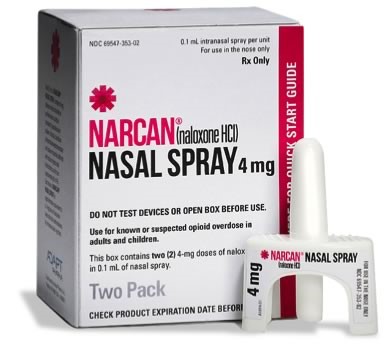
- Administering Naloxone does not conflict with the PSW’s scope of practice. Although PSWs are prohibited from inserting anything under the skin or into the body, using Naloxone nasal spray is time-sensitive. Therefore, the OPSWA (Ontario Personal Support Workers Association) maintains that the use of Naloxone Nasal Spray does not breach the scope of practice for a PSW.
- PSWs are legally permitted to use a Naloxone Nasal Spray kit if they are present when a client is experiencing an opioid overdose.
- Ontario’s Good Samaritan Act (2001) offers legal protection to individuals in specific situations, including when a person administers Naloxone to someone experiencing an overdose.
- Naloxone remains active in the body for only 20 to 90 minutes, while the effects of most opioids can last longer. This means that Naloxone’s effects are likely to wear off before the opioids are completely metabolized, which could result in a recurrence of respiratory distress.
- An overdose always constitutes an emergency. Even if Naloxone has been administered, it is crucial to call 911.
- After EMS has arrived and taken over the client’s care, please report to the office at 416-635-2860.
Signs of an overdose:
- Difficulty walking, talking, or remaining awake
- Blue lips or nails
- Very small pupils
- Cold and clammy skin
- Dizziness and confusion
- Extreme drowsiness
- Choking, gurgling, or snoring sounds
- Slow, weak, or absent breathing
- Inability to awaken, even when shaken or shouted at
Required Supplies:
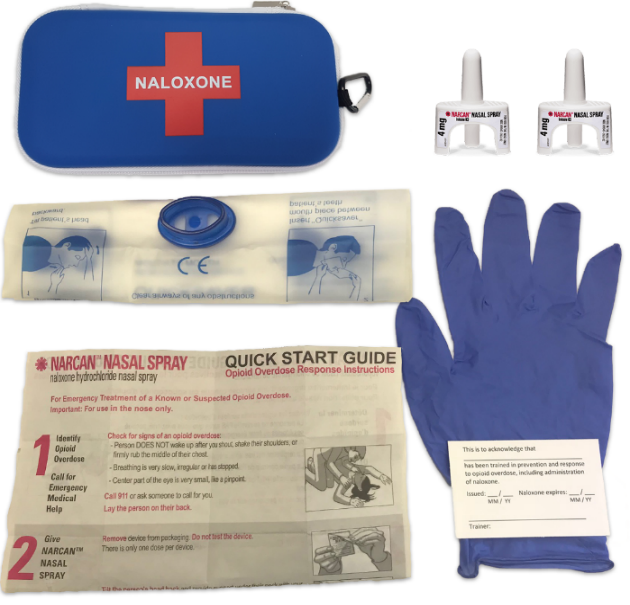
- Naloxone kit
- Each Nasal Spray Naloxone kit includes:
- 1 hard case (for example, a zippered hard black case with red “naloxone” cross)
- 2 doses of Naloxone hydrochloride intra-nasal spray (4 mg/0.1ml)
- 1 one-way breathing barrier
- 1 pair of non-latex gloves
- 1 insert with instructions (English and French)
Procedure for Naloxone Administration:
- Lay the client on their back to receive a dose of NARCAN Nasal Spray.
- Remove the NARCAN Nasal Spray from the box. Peel back the tab with the circle to open the NARCAN Nasal Spray.
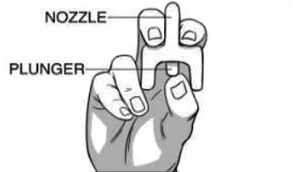
- Hold the NARCAN Nasal Spray with your thumb on the bottom of the red plunger and your first and middle fingers on either side of the nozzle.
- Tilt the client’s head back and provide support under their neck with your hand. Gently insert the tip of the nozzle into one nostril until your fingers on either side of the nozzle are against the bottom of the client’s nose.
- Press the red plunger firmly to give the dose of NARCAN Nasal Spray.
- Remove the NARCAN Nasal Spray from the client’s nostril after giving the dose.
- Get emergency medical help right away – Call 911.
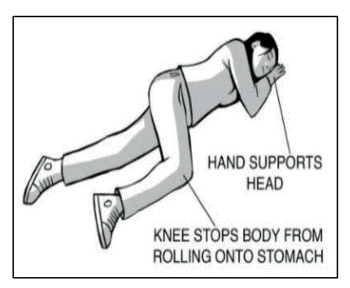
- Move the client on their side (recovery position).
- Watch the client closely.
- If the client does not respond by waking up to voice or touch, or breathing normally, another dose may be given.
- NARCAN Nasal Spray may be dosed every 2 to 3 minutes
- If additional NARCAN Nasal Sprays are available, Steps 2 through 6 may be repeated every 2 to 3 minutes until the person responds or emergency medical help is received.
Special notes:
- If the client continues to be un-responsive, administer another dose of Naloxone if available, call 911, and begin CPR.
- Please note that the Ontario Naloxone Program (ONP) serves community-based organizations that are not pharmacies or linked to pharmacists.
- Pharmacies/pharmacists interested in participating in distributing naloxone kits should refer to the information on the Ontario Naloxone Program for Pharmacies (ONPP).
Video Resource
Please click on the video link below for a visual demonstration of the procedure:
References:
Drug Policy Alliance. (2022). Naloxone. https://drugpolicy.org/issues/naloxone
Government of Canada. (2019. April 11). Naloxone: Save a life (fact sheet).
https://www.canada.ca/en/health-canada/services/publications/healthy-living/naloxone-save-a-life-fact-sheet.html
NARCAN. (2021). Instructions for use NARCAN (nar´ kan) (naloxone hydrochloride)
Nasal Spray “. https://www.narcan.com/wp-content/uploads/2021/10/Gen2-Instructions-For-Use.pdf
NARCAN Nasal Spray. (2021, December 27). Manufacturer’s Training Video [Video].
YouTube: /www.youtube.com/watch?v=KEOq6fUWNtA&ab_channel=NARCAN%C2%AENasalSpray
National Harm Reduction Coalition. (2020, September 1). Opioid overdose basics: Responding to opioid overdose. https://harmreduction.org/issues/overdose-prevention/overview/overdose-basics/responding-to-opioid-overdose/
Occupational Health and Safety Act. R.S.O. 1990, CHAPTER O.1. Last amended 2022.
https://www.ontario.ca/laws/statute/90o01/v42#BK49
Ontario Ministry of Health. (2023, January 30). Naloxone.
https://www.health.gov.on.ca/en/pro/programs/drugs/naloxone/naloxone_faq.aspx