
Colostomy: A bowel diversion which may be necessary due to certain disease processes (e.g. cancer). The intestines are brought towards the abdominal wall, resulting in a stoma, which passes stool or effluent. A colostomy pouch is used to collect and hold the stool or effluent.
PSW Considerations:
- Encourage the client to be involved in the procedure as much as possible to promote independence.
- Notify the office immediately at 416-635-2860 if any of the following are observed:
- If there is a smaller or larger amount of stool output than usual.
- If the client complains of cramping, abdominal pain, or looks dehydrated.
- Common signs of concerns with the client’s stoma:
- Bulging
- Getting larger
- Darkening in colour or turning bluish
- Common signs of poor skin health around the client’s stoma:
- Redness
- Irritation
- Signs of leaking around the pouch or skin barrier
- Bleeding
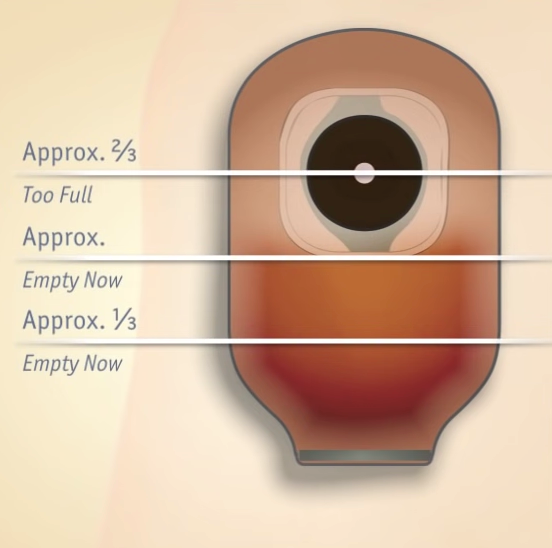
Required Supplies:
- Clean gloves
- Basin for stool collection (if the toilet is inaccessible)
- Wash cloth
- Soap
- Tissues, paper towels, or sanitary wipes if available
Procedure for Emptying the Ostomy Pouch:
- Position the client appropriately and ensure that privacy is maintained.
- Explain the procedure to the client at their level of understanding.
- Wash hands thoroughly. Put on gloves.
- Inspect the area around the stoma for:
- Redness
- Irritation
- Signs of leaking around the pouch or skin barrier
- Bleeding
- Inspect the stoma for signs of:
- Bulging
- Getting larger
- Darkening in colour or turning bluish
- Raise the pouch so that the opening faces up.
- Open the pouch.
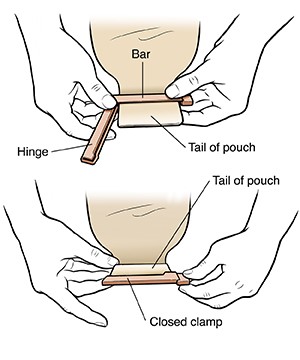
- Either unclamp or unroll the integrated drainage outlet.
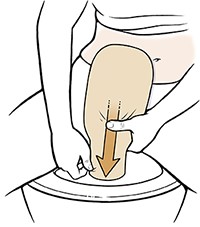
- Lower the pouch towards the toilet or collection container.
- If emptying into the toilet, place a piece of toilet paper in the toilet to prevent splashing.
- Slide your hands down the pouch to push out the stool.
- Wipe the opening of the pouch.
- Re-clamp or reseal the pouch.
- If the area around pouch is soiled, wipe it down with water and a cloth to clean it until the appliance can be changed.
- Remove gloves and wash hands thoroughly.
- Report any unusual findings, concerns, or changes to the client’s health to your CSS.
Video Resource
Please click on the video links below for a visual demonstration of the procedure:
References:
American College of Surgeons. (2016, February 10). Adult colostomy/ ileostomy.
https://www.facs.org/for-patients/home-skills-for-patients/ostomy/adult-colostomy-ileostomy/
American College of Surgeons. (2013, March 7). Colostomy/ ileostomy: Emptying a pouch [Video]. YouTube. https://www.youtube.com/watch?v=JrtO2KkLZsQ&ab_channel=AmericanCollegeofSurgeons
CareChannel (2019, October 4). How to empty & change an ostomy bag [Video]. YouTube.
https://www.youtube.com/watch?v=FXKM1r5L8U8&ab_channel=CareChannel
Hollister. (2023). Ostomy care: Quick educational tools.
https://www.hollister.com/en/ostomycare/educationaltools#
MedlinePlus. (2022). Changing your ostomy pouch.
https://medlineplus.gov/ency/patientinstructions/000204.htm
Potter, P., Perry, A. G., Stockert, P., Hall, A. (2019). Canadian fundamentals of nursing (6th ed,. Astle, B. J., & Duggleby, W. Eds.). Elsevier Canada.
School Health Associates. (2021). Emptying colostomy pouch.
https://schoolhealthassociates.com/emptying-colostomy-pouch/
Wound Management & Prevention. (2010). Testing a computer-based ostomy care training resource for staff nurses. https://www.hmpgloballearningnetwork.com/site/wmp/content/testing-computer-based-ostomy-care-training-resource-staff-nurses