
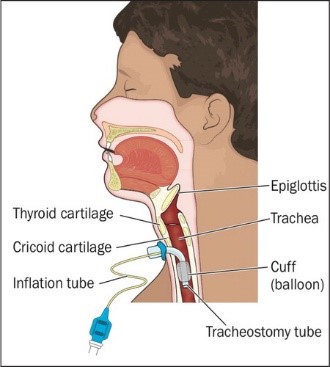
Tracheostomy: A surgical opening made through the neck and into the trachea (windpipe). A breathing tube is inserted into the trachea to open the airway and aid with breathing. The tracheostomy tube and equipment must be cleaned and maintained regularly to reduce the risk of a blockage in the tube from secretions, maximize gas exchange, and minimize the work of breathing.
CSS Considerations
- PSWs are not authorized to suction tracheostomy tubes.
- Tracheostomy care in the community is performed using a clean technique.
PSW Considerations
- Report to the office at 416-635-2860 if:
- The client feels increased pain or discomfort
- Secretions become thick, if crusting occurs, or mucus plugs are present
- A mucus plug is thickened, hardened mucus which can form in or around the tube and cause a blockage in the tube
- The stoma (opening where trach is inserted) looks red or infected
- There is blood, pus, or a foul smell
- The tracheostomy tube becomes dislodged
When to call 911
- Remember to report to the office at 416-635-2860 after you have called 911 and when it is safe to do so
- Signs of respiratory distress such as difficulty breathing which may present as a combination of any or all of the following symptoms:
- Rapid breathing
- Sweating
- Wheezing / grunting sounds
- Colour change (e.g. pale, grey, blue, red)
- Nose flaring
Required Supplies
- Gloves (2 pairs)
- Clean 4×4 fine mesh gauze
- Garbage bag or receptacle
- Small brush or pipe cleaners
- Hydrogen peroxide solution (1/2 saline + 1/2 hydrogen peroxide)
- Normal saline
- Water
- Two small bowls (1 for washing, 1 for rinsing)
Procedure for Tracheostomy Care
Remove Inner Cannula
- Gather the necessary equipment.
- Wash hands thoroughly with soap. Put on gloves and a face shield.
- Holding the flange in one hand and the inner cannula in the other, gently twist the inner cannula roll until it unlocks. Ensure the neck plate of the tracheostomy is kept still.
- Place the inner cannula into a bowl.
Washing Inner Cannula
- Non-Disposable Cannula:
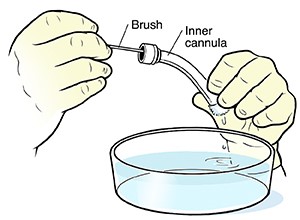
- Wash the inner cannula with a hydrogen peroxide solution.
- Use a brush or pipe cleaner to clean the inside, outside, and creases of the tube. Be certain to clear the inside of mucus.
- Rinse the inner cannula again with water.
- Remove any excess fluid before reinsertion.
- Disposable Cannula:
- Discard in the garbage disposal.
- Insert a new cannula.
Insert Inner Cannula
- Insert the clean inner cannula into the tracheostomy. Hold the neck plate of tracheostomy still. Make certain that the inner cannula is locked in.
- To ensure the inner cannula is locked into position, gently pull forward on the inner cannula.
- Ensure the client is comfortable following the reinsertion.
- Remove gloves and perform hand hygiene.
Washing Outer Cannula
- Put on new gloves.
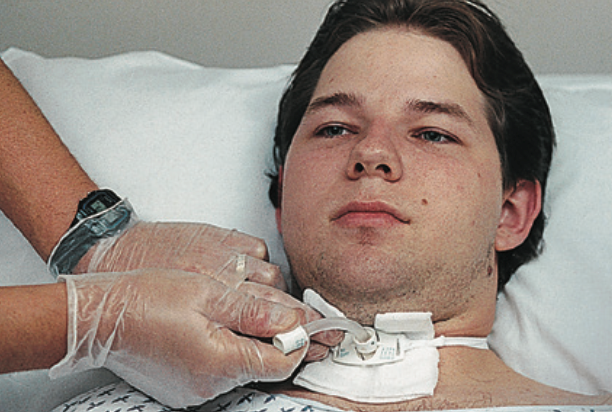
- Remove the soiled gauze dressing from around the client’s neck and dispose in the garbage.
- Inspect the client’s skin around the stoma for redness, hardness, tenderness, drainage, or a foul smell. If detected, report to the office at 416-635-2860.
- Soak a swab in a hydrogen peroxide solution. Use the swab to clean exposed parts of the outer cannula and the skin around the stoma.
- Wet a washcloth with saline or water. Gently wipe away the solution and clean the skin.
- Dry the exposed outer cannula and skin around the stoma with a clean towel.
Changing Tracheostomy Ties
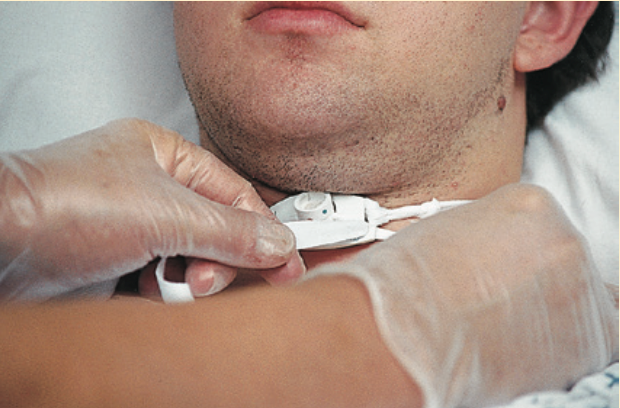
- Measure and cut a piece of tie that is long enough to go around the client’s neck twice. Cut the tie at an angle to make it easier to insert into the neck plate.
- Untie one side of the old tie and remove that side from the neck plate. Do not completely remove the old tie until the new one is in place and securely fastened.
- Holding the tracheostomy tube in place:
- Place the tie through one hole of the neck plate.
- Pass the tie around the back of the client’s neck.
- Then through the other hole of the neck plate.
- Pass the tie again around the back of the client’s neck.
- Pull the tie snugly and tie a knot on the side of their neck. There should be enough space for no more than two fingers between the tie and the client’s neck.
- Cut, remove, and discard the old tie.
- Place a fine mesh gauze under the tracheostomy tie and neck plate by folding it or cutting a slit in it.
- Ensure the client is comfortable following the change of the tracheostomy tube ties.
- Remove gloves and wash hands thoroughly with soap.
Video Resource
Please click on the video link below for a visual demonstration of the procedure
Starting at 4:43
References
- Bhatti, N. (2023, February 23). Living with a tracheostomy tube and stoma.
https://www.hopkinsmedicine.org/health/treatment-tests-and-therapies/living-with-a-tracheostomy-tube-and-stoma - Bhatti, N. (2023, April 11). Tracheostomy.
https://www.hopkinsmedicine.org/health/treatment-tests-and-therapies/tracheostomy - Cleveland Clinic. (2022). Tracheostomy.
https://my.clevelandclinic.org/health/treatments/23231-tracheostomy - Craig Hospital. (2020, May 3). Tracheostomy care and cleaning [Video]. YouTube.
https://youtu.be/25BkOeGO16k - Johns Hopkins Medicine. (2019). Signs of respiratory distress.
https://www.hopkinsmedicine.org/health/conditions-and-diseases/signs-of-respiratory-distress - Mount Nittany Health. (2021, May 8). Tracheostomy, cleaning your.
https://mountnittany.org/wellness-article/tracheostomy-cleaning-your - Nationwide Children’s Hospital. (n.d.). Tracheostomy tube care with a reusable inner
cannula. https://www.nationwidechildrens.org/-/media/nch/family-resources/helping-hands/documents/hhii191.pdf - National Tracheostomy Safety Project. (2017, November 6). Cleaning or changing inner
cannula [Video]. YouTube. https://youtu.be/TFFl7pU51yI - Nepean Hospital. (2005). Tracheostomy care guidelines.
http://www.tracheostomia.com/june_nepean_tracheostomy_care_guidelines.pdf - Santa Fe College Educational Media Studio. (2018, March 1). SF Nursing Trach Care
Part 2 Change Wash Inner Cannula [Video]. YouTube. https://youtu.be/EWAA_saUDSo - Skills Lab. (2017, August 20). Providing Tracheostomy care [Video]. YouTube.
https://youtu.be/R54v1YDrmxM?t=283 - Technology For Living. (2011, November 3). Trach Care and Cleaning Inner Cannula
[Video]. YouTube. https://youtu.be/d2wSiWuTxoc