Body Mechanics

Body mechanics are defined as the coordinated effort of muscles, bones and the nervous system. They help you maintain your balance, posture & body alignment during movement. The goal with proper body mechanics is to prevent injury (most commonly lower back strain).

Musculoskeletal disorders are painful disorders of muscles, tendons, and nerves that develop over time from tasks that repeatedly cause stress and injury to tissues. Musculoskeletal Disorders (MSDs) are the most frequent type of lost time injury and the single largest source of lost-time costs in Canada.

Symptoms of MSDs

  • Pain
  • Joint stiffness
  • Muscle tightness
  • Redness
  • Swelling
  • Numbness
  • Skin colour changes
  • “Pins and needles” sensation

Common Causes of MSDs

  • Repetitive motions: pushing, pulling, lifting
  • Furniture layout and tech use (keyboard/computer/phones)
  • Awkward body motions or tools
  • Pace of work
  • Production pressure
  • Lack of recovery time

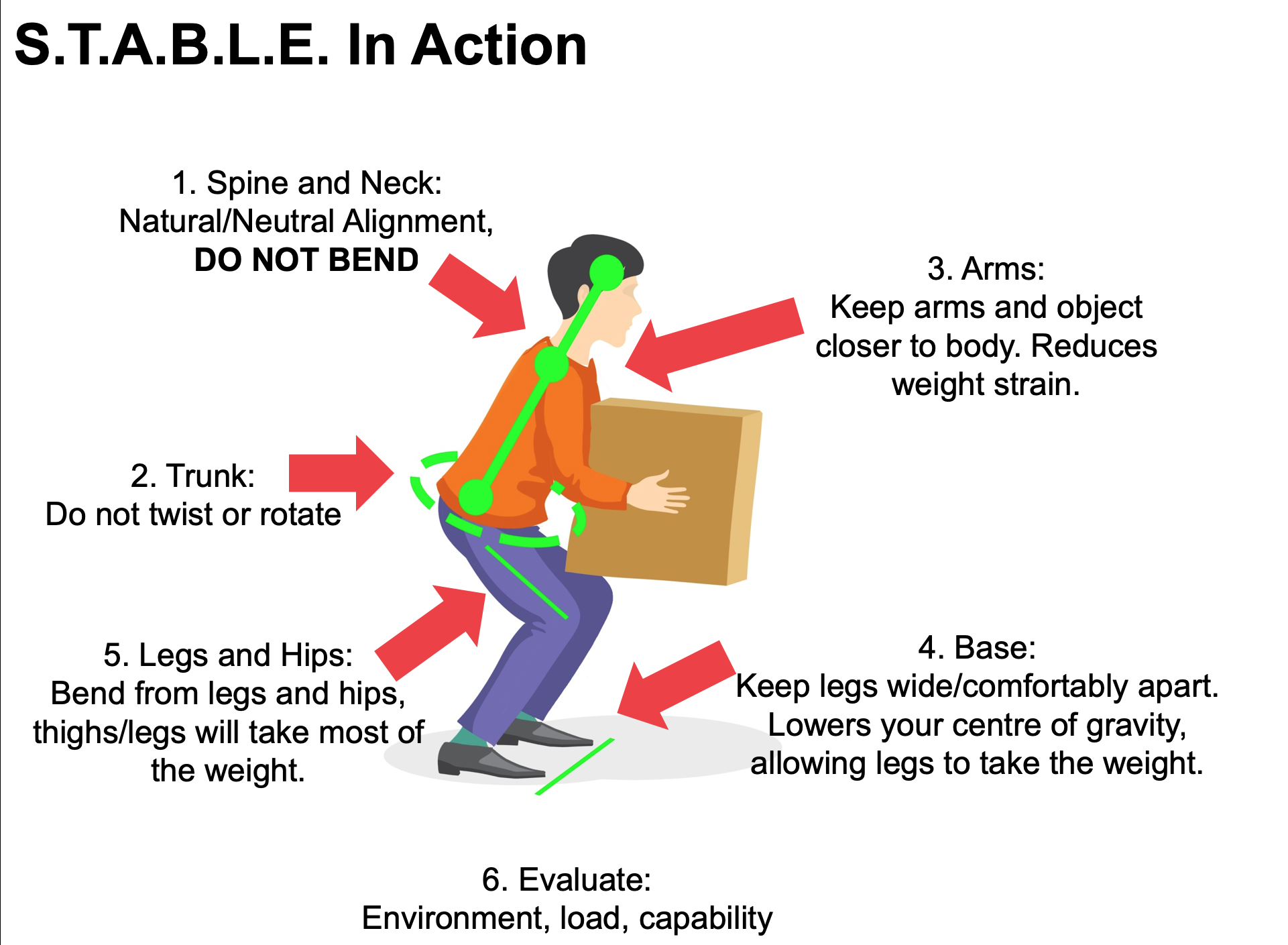
S.T.A.B.L.E.

S.T.A.B.L.E. is used during all moving and handling activities

  • Spine & Head: Keep in neutral/straight position
  • Trunk: Avoid twisting, move in the same direction that you moving the object or person.
  • Arms and Objects/Person: Keep Close to body/Centre of Gravity
  • Base of Support: Keep legs wide/comfortably apart, one foot in front of the other.
  • Legs: Lift, push, pull from the legs, not back.
  • Evaluate: Evaluate these four components. This allows you to identify risks prior to completing the activity.
    • Load: The person or object you are moving
    • Individual: You and your capability to complete the action
    • Task: the actual moving and handling activity
    • Environment: all the factors in the space you are performing the task.

Injury Prevention

Your job as a Personal Support Worker or Homemaker involves a lot of physical activity. You will need strength and flexibility in the back, abdominal, arm, and leg muscles. Regular exercise and stretching of these muscles every morning will prepare you for work and protect your back.

Practicing good body mechanics will help you to avoid injury. (Body mechanics means maintaining the body in the best possible position so that the forces of gravity acting on body weight and load do not add more stress or strain on your back).

Back Care

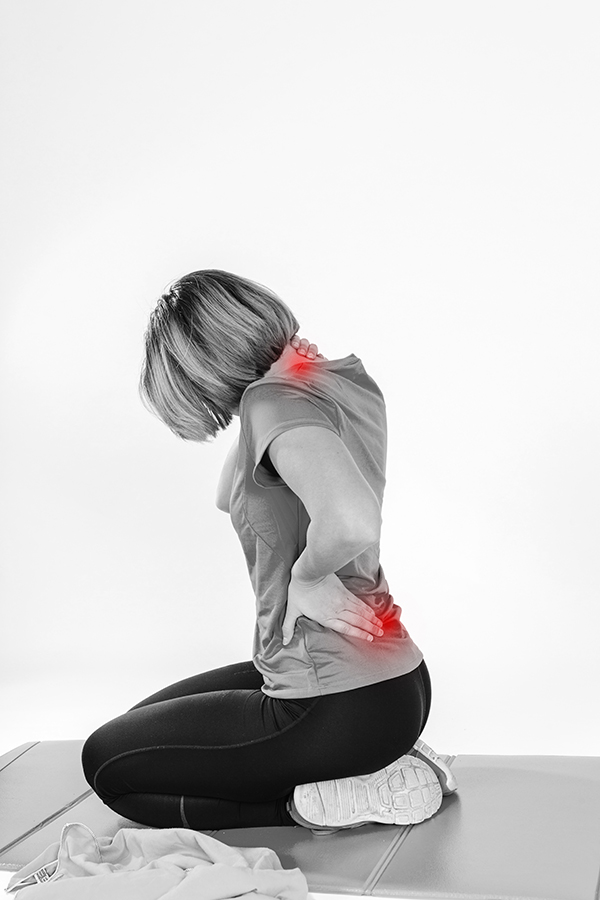
woman holding neck and back, highlighted in red

The way you use your back is very important. If you work in quick, rough motions or if you take positions that bend or twist your back awkwardly, you may become injured. You must be aware of your back and remember to be careful at all times. Making sure that your back is healthy and pain-free will help to make your work more enjoyable.

Using the following tips and techniques to improve your posture may help to prevent back pain or injury:

Pelvic Tilt While standing

  • Keep your weight evenly on both feet
  • Tuck in your buttocks to help strengthen your spine
  • Pull your stomach in
  • Keep your head up and chin in
  • Relax your arms

If you must stand for any length of time, place one foot on a stool or step, shifting periodically from one foot to the other.

While sitting

  • Sit in a firm chair with a straight back
  • Use a chair with arms to prevent neck and shoulder strain
  • Keep knees bent and above level of hips by using a footstool or telephone book under your feet
  • Never slouch, slump or twist in your chair; never sit leaning forward

While sleeping

  • Sleep on a firm, supportive mattress
  • It is best to sleep on your side, with knees bent
  • If you sleep on your back, support your head, shoulders, and knees with pillows

General exercise such as walking or swimming is good for your entire body, including your back. Whether you are working or playing, use your back with care. Know the correct way of performing every task to avoid strain on your back. Always bend your knees when you kneel or bend over.

Lifting and Transferring

The position of your body and the technique that you use to lift, transfer clients or do household tasks is important if you want to reduce strain on your back.

Follow these tips:

Transferring

  • Only transfer clients who can bear some weight through their legs
  • Make sure that the client knows where and when to move. (You might say, “Mrs. Smith, on the count of three we are going to move to the couch. Is that okay?”).
  • Keep your feet about shoulder-width apart.
  • Place one foot closest to the destination in the direction of the transfer, then pivot both feet in this direction.
  • Avoid twisting your back. Bend your knees!
  • If the client slips, lower him/her gently to the floor avoiding twisting your back. Get help if the client is unable to assist in getting up.
  • Do not transfer clients into or out of the bottom of the tub. If the client is unable to get in or out of the tub independently, then a special tub seat must be used. (The tub or shower should always have a non-skid mat).
  • Remember to support the client’s weaker side.

As a Personal Support Worker, you do a variety of household management tasks that are physically demanding and expose your back to possible injury. The most common cause of back injury among health care workers is lifting.

Lifting

  • Position your feet for balance – about shoulder-width apart, one foot slightly ahead of the other.
  • Bend your knees, keeping your back as straight as possible. Never bend at the waist with straight legs.
  • Avoid touching the floor with both knees.
  • Get a good grip on the object.
  • Keep arms and the object close to the body at waist level.
  • Use leg muscles, hips and knees while lifting. They can withstand much more than your back.
  • Tighten your stomach muscles to utilize the spine.
  • Turn your feet in the direction of your turn.
  • Avoid twisting as you lift.
  • Avoid lifting from the floor or from overhead.

IF YOU THINK AN OBJECT IS TOO HEAVY TO LIFT BY YOURSELF . . . DO NOT TRY TO LIFT IT!

Bending

Another back tip is to perform bending safety. Always remember when cleaning under beds or under furniture to:

  • Kneel down on one knee
  • Bend knees and hips, not your back
  • When bending forward, move your whole body, not just your arms.

It is also important to keep your back healthy when using repetitive motions such as stacking items. Always remember to:

  • Keep loads small
  • Turn your whole body instead of twisting
  • Get close to the load rather than reaching
  • Lift your arms and legs, not your back
  • Tighten your stomach muscles to lift
  • Change positions frequently

Pushing & Pulling

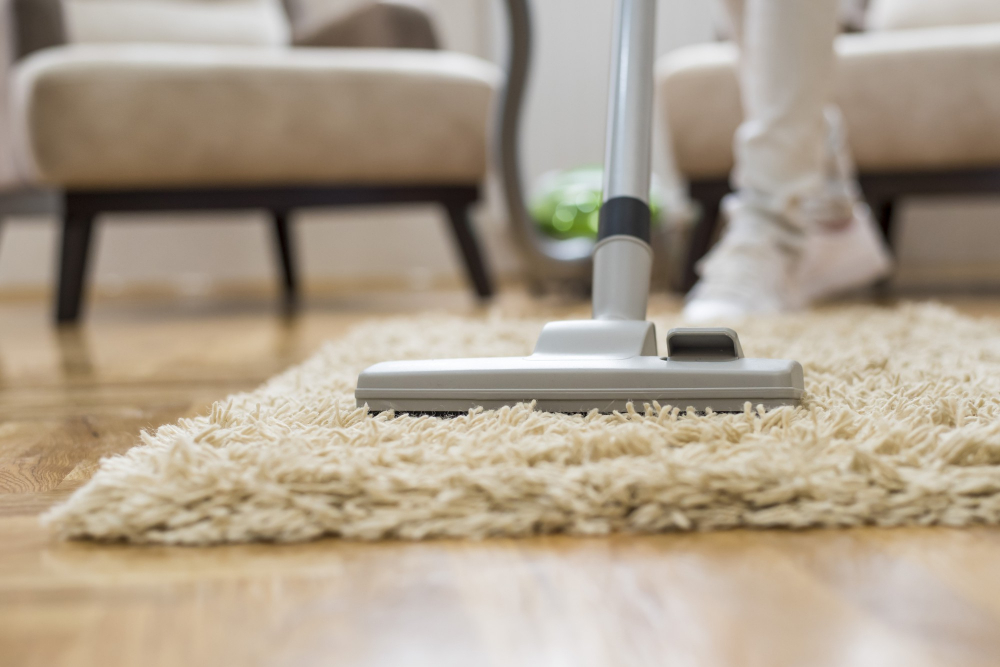
A final tip relates to the pushing and pulling of large objects such as vacuum cleaners.

Always remember to:

  • Stay close to the load instead of leaning forward
  • Whenever possible, push rather than pull to avoid strain
  • Use both arms
  • Tighten your stomach muscles when pushing